The first summer I ran back-to-back bookings, I set an 11:00 checkout and a 14:00 check-in because that is what the previous host had used. Four Saturdays in a row my cleaner sent the same text: "running behind, guests are already in the hallway." A two-bedroom takes her three and a half hours with the laundry on-site. I had handed her three. The incoming guests kept walking into a made-up bed and a wet bathroom floor, and I spent a month convinced I had a cleaner problem.
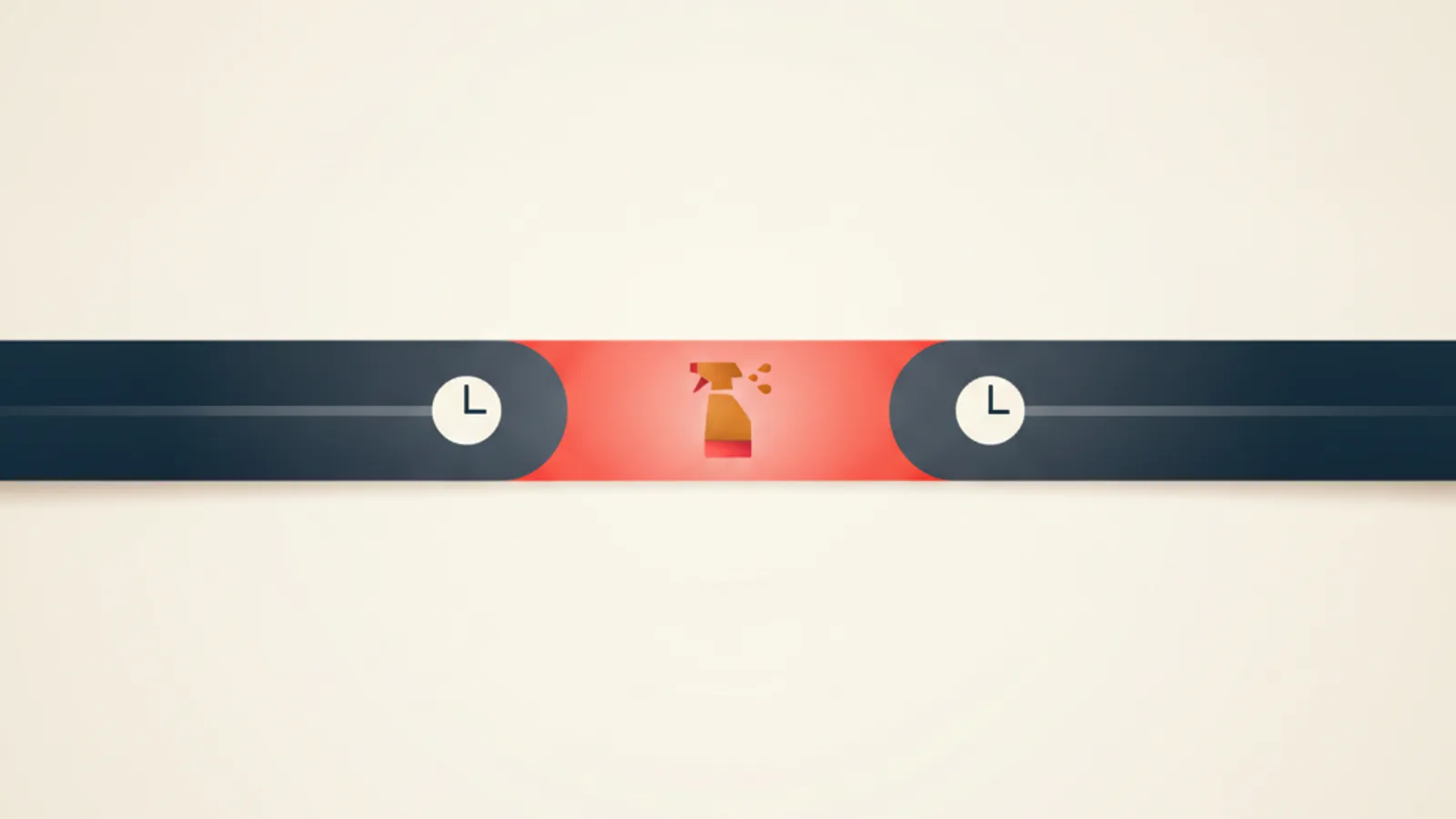
I had a clock problem. The single number that decides whether a same-day turnover works is not your cleaner's speed — it is the gap between the hour one guest leaves and the hour the next one walks in. Set that gap too narrow and no cleaner alive turns the unit in time.
The window is check-in minus checkout, and only on turnover days
The whole calculation only exists on a same-day turnover — one guest checks out and another checks in the same day. If there's a vacant night between two stays (a gap night), the cleaner has the entire day and none of this matters. So the first thing to know is how often you're actually in this situation, and that scales straight off occupancy.
At 50% occupancy, most changeovers land on a vacant night and your window is 24 hours. At 85%-plus, most changeovers are back-to-back, and the window collapses to the handful of hours you write into your listing. High occupancy is the goal, so the busier you get, the more this number governs your operation — see the occupancy-rate math for why the denominator matters.
Airbnb's defaults are an 11:00 checkout and a 15:00 check-in: a four-hour window. Booking.com is similar, usually checkout by 11:00 and check-in from 14:00 or 15:00. That four hours is the entire budget your cleaner has on a turnover day. Every minute you shave off the checkout, or add to the check-in, is one more minute of cleaning time — bought with one minute of guest goodwill.
How long a turnover actually takes
Hosts routinely underestimate this because they time themselves doing a relaxed clean on a gap day, not a cleaner doing a full changeover against a clock. Here is a realistic breakdown for a two-bedroom, one cleaner, laundry done on-site:
| Task | Time |
|---|---|
| Strip and remake two beds | 30 min |
| Two bathrooms, full | 35 min |
| Kitchen, dishes, surfaces | 25 min |
| Vacuum and mop all floors | 30 min |
| Restock consumables, stage, photos | 20 min |
| Laundry (wash + dry, on the critical path) | 60+ min |
| Final walk-through and inspection | 10 min |
The bare cleaning is roughly 2.5 hours. On-site laundry is the killer: you can't remake the second bed until the sheets are dry, so a single set of linen puts a 60-minute wash-and-dry cycle directly on the critical path and pushes the whole turnover to 3.5 hours. Keep two or three linen sets per bed and the laundry comes off the critical path entirely — the cleaner makes the bed with a fresh set and washes the dirty one later. That one decision buys back an hour of window; the full trade-off is in linen inventory math.
Rough turnover times by unit size, single cleaner:
- Studio / 1-bed: 90 minutes to 2 hours.
- 2-bed: 2.5 to 3.5 hours, laundry being the swing.
- 3-bed and up: 3.5 to 4.5 hours, and you should be questioning the single-cleaner assumption.
The window-width trade-off
Here's what each window width actually buys you. "Fits" assumes one cleaner and enough linen sets to keep laundry off the critical path.
| Window | Times | Fits | Slack | Risk |
|---|---|---|---|---|
| 3 hr | 11:00 → 14:00 | Studio–1 bed | 30–60 min | Any hiccup blows it |
| 4 hr | 11:00 → 15:00 | Up to 2-bed | 30–60 min | The sensible default |
| 5 hr | 11:00 → 16:00 | 2-bed + on-site laundry | Comfortable | Costs one guest-hour |
| 6 hr | 10:00 → 16:00 | Two nearby units, one cleaner | Maximum | Costs two guest-hours |
The pattern: three hours is a trap for anything above a one-bed, four hours is the honest default, and every hour past that is bought by leaning on the guest. The question is which end of the day you take that hour from.
Widen the check-in side before you touch the checkout
This is the part most hosts get backwards. When they need another hour of cleaning time, they pull the checkout earlier — 11:00 becomes 10:00 — because it feels symmetrical. It isn't. Guests punish an early checkout far harder than a late check-in.
The reason is the hotel baseline everyone carries in their head: 15:00 check-in, 11:00 checkout. A 16:00 check-in sits one hour above a norm the guest already expects, and most people spend their arrival day in transit or sightseeing anyway — they barely notice. A 10:00 checkout sits one hour below the norm, and it lands at exactly the moment a family is packing, wrangling kids, and trying to eat breakfast. That is the hour that produces the "felt rushed out" line in a review. In my own listings, moving check-in from 15:00 to 16:00 drew zero complaints across a season; the one summer I tried a 10:00 checkout, I got two mentions of it in reviews within a month.
So the rule is simple: to buy an hour of window, push check-in to 16:00 and leave checkout at 11:00. Only reach for the 10:00 checkout when 16:00 still isn't enough — and at that point you should be looking at a second cleaner or a buffer day, not a fifth hour squeezed from the guest.
One cleaner, two properties: the stagger
If you run two units a short drive apart, a single cleaner can turn both on a busy Saturday — but only if the windows are wide and staggered so the two cleans don't collide. The math for two one-bedrooms, one cleaner, 20-minute drive between them:
- Unit A: checkout 10:00, clean 10:15–12:15.
- Drive: 12:15–12:35.
- Unit B: clean 12:35–14:35, check-in 15:00.
That works, but notice Unit A needed a 10:00 checkout and Unit B is fine at 15:00. Push both to two-bedrooms and the second unit's clean runs to 15:35 — now you need a 16:00 check-in on Unit B, or the whole chain breaks. This is exactly why multi-unit hosts drift toward 16:00 and 17:00 check-ins: they're not being stingy, they're protecting a single cleaner's route. The alternative is a second cleaner for the overlapping window, which runs $40–80 a changeover depending on your market — the full breakdown is in what to pay your cleaner.
When to stop widening and block a buffer day
There is a point where no reasonable window fits the clean: a three-bedroom with on-site laundry and one cleaner needs four-plus hours, and you can't take four hours off the guest without a 10:00 checkout and a 17:00 check-in, which is a miserable listing. When you hit that wall, stop stretching the window and block the changeover day instead — a buffer day the platforms can't schedule natively but that a tool like RentTools inserts automatically.
The cost of a buffer day is one night of revenue: at a $120 average nightly rate, that's $120 you didn't collect. It feels expensive. But a rushed turnover doesn't just risk one bad review — it risks the incoming guest walking into a dirty unit, which is the single most reliable way to earn a one-star cleanliness rating, and one of those costs you far more than $120 to dig out of. The decision rule I use: if the realistic turnover time is greater than the window minus a 30-minute safety margin, I either add a cleaner or block the day. I never try to win those 30 minutes by hoping. When a rushed clean does slip through anyway, buffer days are the fix you wish you'd made the week before.
One opinionated take
Your check-in and check-out times are a cleaning-schedule decision wearing a hospitality costume. Hosts set them from what feels generous to the guest, then act surprised when the cleaner can't keep up. Set them from the cleaner's stopwatch instead: measure a real turnover, add a 30-minute margin, and let that number pick your window. A spotless unit at 16:00 beats a half-cleaned one at 14:00 every single time, and the guest who waited an extra hour never mentions it — while the guest who found a wet bathroom floor mentions nothing else.
Frequently asked questions
What check-in and check-out times should I set on Airbnb?
Start with the platform default of an 11:00 checkout and a 15:00 check-in, which gives a four-hour turnover window that fits most units up to two bedrooms with one cleaner. Only change it if your actual turnover time doesn't fit that window — and when you do need more time, push the check-in to 16:00 rather than pulling the checkout earlier.
Is an 11:00 checkout too early?
No — 11:00 is the hotel norm and guests expect it. The mistake goes the other way: pushing checkout to 10:00 to buy cleaning time. That hour lands during packing and breakfast and reads as being rushed out, so it draws more review complaints than a late check-in ever does. Keep checkout at 11:00 and take your extra time from the check-in side.
How long does an Airbnb turnover actually take?
A studio or one-bed runs 90 minutes to 2 hours for a single cleaner; a two-bed runs 2.5 to 3.5 hours depending on whether laundry is on the critical path; a three-bed runs 3.5 to 4.5. On-site laundry with only one set of linen adds a full wash-and-dry cycle to the timeline because the bed can't be remade until the sheets are dry.
Can I run a same-day turnover, or should I block the day?
You can run a same-day turnover as long as your realistic turnover time fits inside the check-in-minus-checkout window with about 30 minutes of safety margin. If it doesn't, add a second cleaner or block a buffer day. Rushing a clean to save one night's revenue is the trade that produces cleanliness complaints.
Does a later check-in hurt my reviews or search ranking?
A 16:00 check-in barely registers with guests because most people spend their arrival day traveling. There's no direct ranking penalty for check-in time. The thing that hurts ranking is a cleanliness or accuracy complaint from a rushed turnover — which is exactly what a too-narrow window produces, so a slightly later check-in usually protects your ratings rather than harming them.
Should I offer early check-in or late checkout on top of this?
Those are separate, fee-worthy decisions that hinge on whether the unit was occupied the night before and the night after. The base times set your standing window; early check-in and late checkout are the paid exceptions. The math for those is in early check-in fees and late check-out policy.
How do I give the cleaner more time without annoying guests?
Three levers, in order of least guest pain: keep two or three linen sets so laundry comes off the critical path, push check-in to 16:00, then add a second cleaner for the tight windows. Pulling the checkout earlier is the last resort, not the first, because it costs the most goodwill per hour bought.
Does blocking a buffer day hurt my occupancy stats?
It lowers occupancy by exactly the nights you block, but occupancy isn't the goal — revenue net of complaints is. A buffer day costs one night's rate; a one-star cleanliness review from a rushed turnover costs future bookings you'll never see. On a high-occupancy calendar, the occasional planned buffer day is cheaper than it looks.
Keep reading
Short-term rental laundry: in-house machines vs a service
What a turnover's laundry really costs in-house versus at a service: per-load math, the extra linen set a 48-hour turnaround forces, and the real crossover.
Consumables cost per stay: the line every host forgets to budget
What toilet paper, coffee, and soap actually cost you per Airbnb turnover — the itemized per-stay breakdown, bulk-vs-retail unit math, and three occupancy scenarios annualized.
Early check-in fee math: when to charge, when it's free money
Worked math for early check-in fees on Airbnb, Booking.com, and Vrbo — the prior-night-vacant rule, what to charge, and why high occupancy kills the supply.
Pet fee math for short-term rental hosts: when allowing dogs actually pays
A worked breakdown of pet fees for Airbnb and Booking.com hosts. Cleaning premium, damage rate, conversion uplift, and the per-listing rule for setting yours.
Late check-out fee policy: what to charge, what hosts actually collect
Worked math for late check-out fees on Airbnb, Booking.com, and Vrbo — hourly vs half-day, when to comp the first hour, and the same-day-arrival cliff.
What to pay your short-term-rental cleaner: per-clean vs hourly
Per-clean, hourly, and monthly-retainer cleaner pay math for short-term rental hosts at 5, 10, and 20 stays a month — plus the contractor-classification trap.
Comments
Sign in to comment.
- No comments yet.